Monday, January 4, 2016

Liangzhu Culture Jade Cong, H. 11.8cm, D. 19cm, 11kgs


Identification :
This cong is similar in design but bigger than the one( H. 8.8cm, E.D. 17.6cm, Weight 6.5kgs ) unearthed from Fan Shan Graveyard, Chih Shan Village, Chang Min Township, Yu Hang County, Zhejiang Province,1986, A collection of Archaeology Institute of Zhejiang Province. Antiquity evidences include differential weathering and additive crystals.
Provenance: Private collection, USA


Contact information: palaceantique@gmail.com

Saturday, January 2, 2016

Hongshan Culture, Jade Eagle, H. 25cm, W. 22cm, 3500grams


 Identification:
The bright and piercing eyes carved with incised lines with the design more reflect the real object to conform the later genre of the Hongshan culture artifacts. On the backside of the eagle are two smooth double slant incised lines between the wings and the body. A double side bugle shape holes pertinent to Hongshan culture is seen on the neck. 
Made of fine quality jade( white tone nephrite has a prominent mode within the low wavenumber range of 600-800 tested by Raman spectrometer with antiquity evidences of differential weathering ,exposed crystal plane and diffusive markings, the style of carving and hole drilling method and ancient tool mark conforms the characteristics of Hongshan culture artifacts, and with perfect workmanship, fine quality jade and big size of 3500 grams and H. 25cm( much bigger than the one H.18.3cm which had been claimed the biggest in 2004 ) , it is a rather rare and extremely valuable Hongshan jade eagle artifact.
Appreciation:
To reflect Hongshan people's dream of flying high in the sky, eagles are one of the main motifs other than the C-dagon or pig dragon for the Hongshan Culture jades. With strong and solid chest and the wings wide open, it seems ready to fly high. The designs of eagle have evolved from simple shapes of more abstract forms into more detail ones.  This eagle is seen detail design to represent the later period Hongshan genre. Coupled with high quality of jade and mastery workmanship, this is a valuable rare Hongshan artifact.
Provenance: Private collection, USA
Contact information: palaceantique@gmail.com

Friday, January 1, 2016

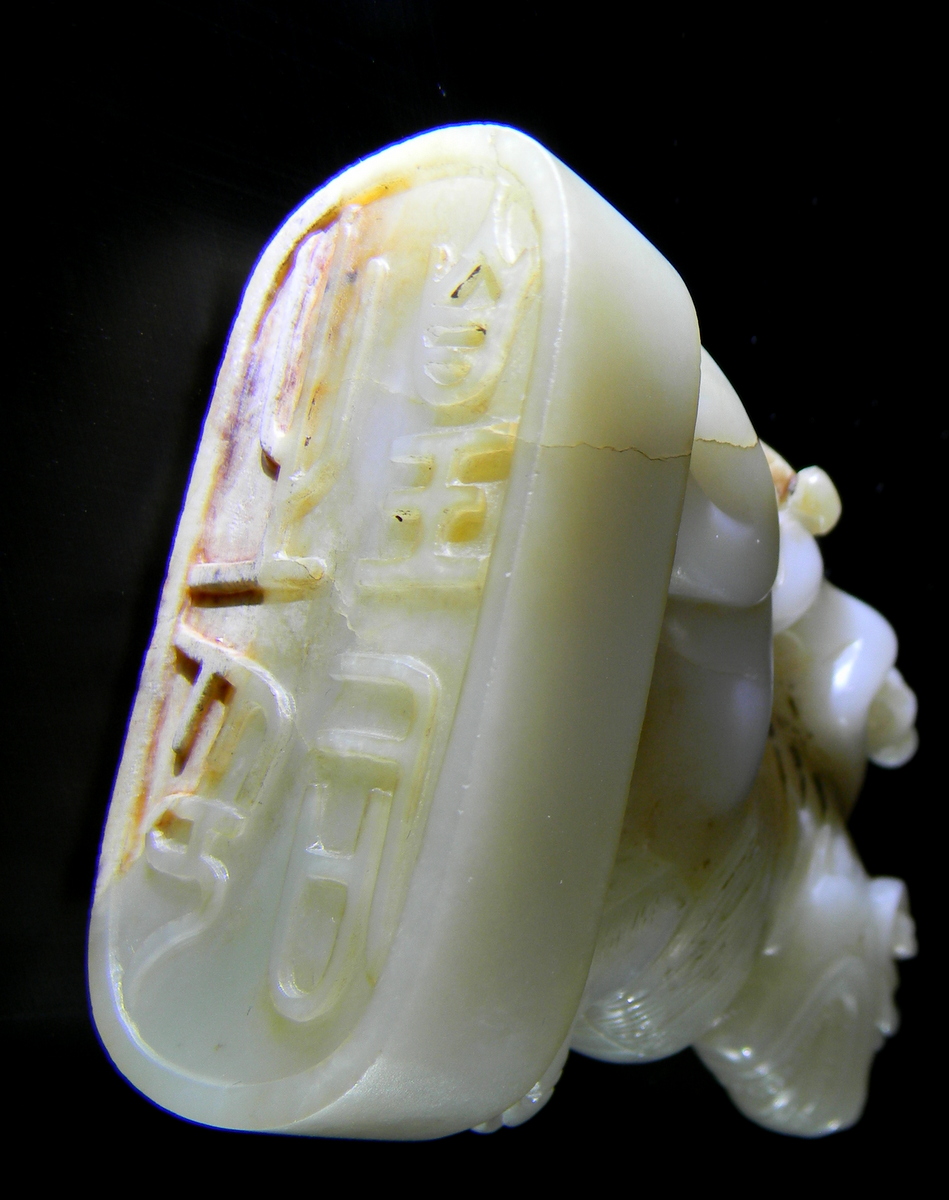
Seal of Empress of the Chin Dynasy (B.C.221-B.C.206) ,Measurement: H.7.5cms,W.6cms.

The style of the scripts on this seal conforms those of the Chin dynasty. bronze seals( around 2.2cmx2,2cm) of the Palace Museum of Beijing ‘s collection. Especially the last stroke of the seal character of this seal    conforms the typical lining of the Chin calligraphy ( petite sigillaire 小篆 ) style. The artifact consists aging elements such as diffusive markings, deteriorate markings, calcification,cleaving veins and differential weathering to prove its antiquity. Based on the carving and characters styles of the jade seal and its antiquity of evidences, this jade seal is authenticated as genuine Seal of the Express from the Chin Dynasty. Emperor and  Empress were first appeared in Chin Dynasty. The Seal of the Empress is the first in Chinese history that makes this seal is an important artifact and and its value is beyond description.
Provenance: Private collection, USA
Contact information: palaceantique@gmail.com


Emperor Kwan-Wu of Eastern Han Mutton Fat White Jade Paperweight, H. 7cm, D. 7.5cm, Weight: 500g.

Identification:
This seal-form paperweight (paper had been used before Eastern Han Dynasty ) is made of mutton white jade (test result from gem lab ) with carving style of Han Dynasty. The inscription of "Kwan-Wu-Yu-Zhi(光武御製)" on the bottom side of the paperweight has clearly indicated the item belongs to the imperial palace of Emperor Kwan Wu, the first emperor of the Eastern Han dynasty of China. Antiquity evidences include diffusive marking , differential weathering and additive crystal.
Appreciation:
The paperweight has a high relief dragon carving with the body curling around the head. The imposing and majestic looking of the dragon has been thoroughly expressed. In addition, the round and smooth carving has made it easy for holding by hand. It symbolizes that all the livings and properties under the heaven are under the emperor's control. 
Provenance: Private collection, USA
Contact information: palaceantique@gmail.com

Emperor Kwan-Wu of Eastern Han Dynasty (BC6-AD57) Mutton Fat White Jade , H. 15cm, L.18cm, 1.0kg.

  
Identification:
The inscription of "Kwan-Wu-Yu-Zhi(光武御製)" on the chest has identified the original owner of the container which is supposed to be water container called Yan Di (硯滴) in Chinese (writing brush had been used already before Eastern Han). In other words, it was made by the order of the first emperor Kwan-Wu of Eastern Han dynasty about two thousand years ago.  With mastery workmanship, this artifact is made of top quality mutton white jade(see gem lab test result ).  As far as antiquity is concerned,evidences of diffusive marking, deteriorate marking and differential weathering are obvious. 
Appreciation:
The container design of mother carrying baby on the back has seen in the western Zhou Dynasty bronze artifacts. The lid of the container has a young eagle carving. Underneath the tail having two branches( having similar style to that of the bronze bird container ) of the mother eagle protecting a young dragon. The mother eagle is staring backward at both the young eagle and the young dragon to make sure they are nicely taken care of. The noble character of loving not only her own loved but also the others has fully been expressed. This theme conforms the Emperor Kwan -Wu's economic policy of paying attention to people's livelihood, resting with the people. The motif of the dragon is seen on both wings, with the Ruyi ( fulfill of one's wishes) curly cloud motif on the tail. Both motifs are the symbol of nobleness and luck. Fairly unique among emperors in Chinese history was Emperor Guangwu's combination of decisiveness and mercy. He often sought out peaceful means rather than bellicose means of putting areas under his control. He was, in particular, one of the rare examples of a founding emperor of a dynasty who did not kill, out of jealousy or paranoia, any of the generals or officials who contributed to his victories after his rule was secure. The main theme of this jade artifact has fully expressed this.Judging from the perfect design made of top quality jade and historic significance, this artifact is no doubt one of the most valuable ones for serious collectors.

Tuesday, September 17, 2013

Jade Identification --Scientific Method

There were works on jade identification theory and practice  since the Song and Yuan dynasties. While there are so many divergent views on jade identification, the scientific identification of the ancient jades has been recognized by industry, government and academia. I have done a study presented to a Taipei conference only served as a practical summary to them. In addition, my study attempts to provide a reference comparison method to identify handed down jades without unearthed reports. In the article on Mineralogical Studies of Archaic Jades (p. 199 no. 32, Acta Geological Taiwanica), Prof. Tsien, H. H. has presented the scientific method on jades identification. Since then, the scientific method on jades identification by Prof. Tsien has gained universal acceptance from both academia and professionals. According to Prof. Tsien, Identification of jade antiques consists of three aspects:  
1. authenticity of jade antiques , 2. material composition identification, 3. time period verification.
Authenticity of jade antiques may be verified through certain physical and chemical characteristics including dissolved pits, cleaving veins ,differential weathering, diffusive markings( which should not be mistaken as raw jade skin ), exposure crystals and mineral attachments such as gold placer, Deterioration marking(Aging Spot or ant's leg or cow's hair), underground deterioration and secondary crystal planes which are suitable to serve criteria of authenticity of jade artifacts:
  Cleaving Veins:The cleaving veins seen inside the jade artifact are caused by the interaction of jade to the physical factors of heat and pressure. They are different from the cracks caused by percussion. Usually there are no exterior cracks for cleaving veins and exterior cracks are common phenomena for cracks caused by percussion. These are crystals from the jade itself due to physical factors such as heat and pressure. Underground Deterioration: The channel like natural deterioration are caused by underground chemicals. Additionally, material composition may be reliably and scientifically identified through instruments such as a reflectometer and Raman spectrometer. Generally, nephrite has a refractive index of 1.61 (jadeite has a refractive index of 1.66 )or has a prominent mode within the low wavenumber range of 600-800 and around 3700 high wave number reading via Raman spectrometer. In addition, the hardness of nephrite is 6.5 to 7, while the serpentine has a hardness of 5 to 6. The hardness can be tested by a knife on an not important spot.
To identify the time period of a particular jade artifact may be based on factors including carving style, motifs and designs of the object  considered and characters( if any ) on the jade, (please read information on  Chinese jade chronology.). Above all, according to jade identification expert Dr. Daphne Rosenzweig, jade artifacts should be dated via analytic and systematic approaches. An excellent paper by Eric J. Hoffman is highly recommended to read for more information.


Monday, September 16, 2013

Jade Identification--Hole Drilling Patterns Seen in the Chinese Antique Jades

The irregular surface seen in the hole of authentic jade artifacts of many periods is believed due to the result of particular instruments different from modern ones. As such, those holes are difficult to intimate applying modern tools for fake jades. In addition, holes of artifacts of different periods are shown to have particular patterns. Generally speaking, holes of Hongshan and Liangzhu Cultures jades share same patterns of dual holes having irregular inner surface or helical scoring on the same side. Jade artifacts of the Xia Dynasty have holes having double surfaces fine carved on both sides. Holes of Qijia Culture jade artifacts are seen one directional drilling with irregular remains at the end. As such, hole drilling patterns of different cultures are vital factors to be considered in jade identification.

Sunday, September 15, 2013

Jade Authentication--How to Authenticate Jade Artifacts Without Unearth Report?

It is believed that the quantity of jade artifacts without unearth report is far greater than those of with unearth report. As a result, to authenticate jade artifacts without unearth report is more important than to authenticate those with unearth report as well as is more difficult. Fortunately, modern technologies are available to make jade artifacts authentication as accurate as possible. Among them, reference method may be one the jade authentication methods which seems to be appropriate.

 The reference method may be described as follows: Firstly, we select a referral jade artifact with unearth report which was designated as a particular period such Han Dynasty. Secondly, we list all the referral item's attributes of antiquity phenomena due to chemical and physical factors cleaving veins, differential weathering, diffusive markings exposed additive crystals crystal planes and dissolved pits, the attributes of motifs( for example, the detail of dragon) of that particular period and the attributes of craftsmanship due to carving,hole drilling( for example, the Qijia Culture jade artifacts are characterized by the one directional drilling, ) and formation of lines( for example, the lines on the Hongshan Culture artifacts are usually seen round smooth channel). Thirdly, we repeat the work for the item to be identified. Lastly, we map the attributes of the item to be identified to those of the item referred. If we end up with all the attributes matched, then we can infer that the item to be identified should be from the same period of the item referred. If 90% of the attributes matched, then we can infer that the item to identified has a probability of 90% from the same period of the item referred. Generally speaking, at least 70% is required to be confident that the item to be identified should be from the period of the item referred.(Click the images on this page to read the descriptions for each item: Warring States Huang, W. 7.4cm, H. 7.4cm, T. 0.4cm, 40grams Jade Plaque w/Motif of Phoenix & Dancing Lady, W. 15cm, H. 8cm, 110grams Late Spring Autumn Period Jade Huang, L. 13.2cm, W.2.8cm, T. 0.5cm, 45grams Warring States, Jade Bi, D. 8.7cm, T.0.5cm Warring States, Jade Huang, L.12.5cm,  W. 5.6cm, 82grams</a> ) If the period of the jade artifact to be authenticated has no reference jade artifact with unearth report, then we may search artifacts of different material such as bronze to find clues such inscriptions to make the comparison. For example, we have applied this method for the authentication of the Shin dynasty (AD. 8-25) Octagon-shape Jade Container with Dragon and Phoenix Motif and Inscriptions. For seal, the identification should be based on the scripts on the base and the style of motifs such dragon & phoenix of the handle.

Saturday, September 14, 2013

Jade Authentication--How to Distinguish Between Genuine Jade Artifacts and Fake Jade Artifacts ?

According to Eric Hoffman: "When considering an allegedly old jade, the first step is to stand back and consider how it looks. Each period of Chinese jade carving embodied a “signature look” for that era. These have been well documented in numerous jade books and museum collections. The collector should be alert for anachronisms, ambiguities, distortions, and other anomalous features that might suggest a fake. Incongruous or never-before-seen motifs, unusual iconography, and unlikely or incorrectly written dates or inscriptions are grounds for suspicion."

He also claimed that : "The collector can “train the eye” by studying museum collections—preferably making the acquaintance of the curator—and by building a solid reference library. But those same excellent, well-illustrated publications that are so useful to the collector have also become “pattern books” for the fake-makers (who sometimes make hilarious mistakes, because they can't see the back of the piece)."
"The Complete Book of Unearthed Jades In China" is an excellent source to study the characteristics of genuine jades artifacts.
The following are examples for you to study:

Jade Appreciation--The Essence of Chinese Jade Artifacts Should Be Rediscovered

The Chinese is a nation who has shown a great appreciation on jade. The jade history in China can be traced back as long as eight thousand years in the Xinglongwa Culture( BC6200-5400 ). The extent the Chinese cherishes jade can be realized by the way the Chinese compares the quality of gentleman to that of jade.
      According to the Book of the Analysis of Chinese Characters(說文解字 Shuo Wen Chieh Tzu) of Hsu Shen(許慎) in Eastern Han dynasty( c. 100 B.C.), a classic definition of jade’s lasting appeal has been presented as follows:
      Jade is a stone of beauty which can be revealed in its five virtues: its luster produces a feeling of warmth, the virtue of humaneness; its translucence enables one to comprehend its inner markings, revealing the virtue of morality; its purity ensures the austere virtue which injures no one.
      It is a greatest happiness to enjoy a jade object of good quality by watching its color, listening its sound, touching its surface and reasoning its vein development.
      Jade artifacts identification has been practices widely and in great detail on the identifying the age and the genuineness of jade objects. The appreciation of jade artifacts should not be only on the historical aspect. More appreciation should be placed on the aesthetics the jade artifact presents. The elegance of Chinese jade will be rediscovered if jade enjoyment can be matched with the final purpose to establish a harmony society by following the virtues of jade. To appreciate Chinese antique jades, please click the above images to experience.

Jade Appreciation--The Admirable Buddhist Jade Carving Arts

The glorious Buddhist arts in China Buddhism has a great impact on the Chinese culture for various respects. The Buddhist culture relics are abundant in the Chinese historical records. The stone carvings found in the caves of Tunhwang, Yunkang and Lungmen are known world wide for their artistic achievements. In the Sui and Tang dynasties, Buddhism has reached its peak. Many Buddhist relics from the Sui dynasty have been kept intact due to the promotion of the rulers. Among the many cave carving of the Sui dynasty, the most abundant and glorious is the Mohrkao cave.  After the Tang dynasty, Buddhism has been combined with the thought of Confucians and the political ideas due to the emphasis of the imperial exploitation and management. In the nineteenth year of Jenkwang of the Emperor Tai Tsung of the Tang dynasty, Master Hsuan Tsang came back from India with 600-odd Buddhist scriptures many of which he and his disciples translated into Chinese. Lungmen Grottoes was carved in the Tang dynasty under the rule of Empress Wu (625-705). Most of the Buddhist statutes found in the Sui and Tang dynasties are carved with jade and guilt with gold. The bases are usually seen with bronze. The style of the Buddhist statues have deep genre of Tibetan sultra school. The motif of flying fairies shown on the aureole of the Buddhist statutes found in the Sui and Tang dynasties conforms the genre of those appeared on the jade objects of the Tang dynasty.

Jade Appreciation --Historical and Cultural Perspectives of Jade Carving Styles and Craftsmanship

Authenticity of jade antiques may be verified through certain physical and chemical characteristics including differential weathering, diffusive markings, exposure crystals and a secondary crystal plane. Additionally, material composition may be reliably and scientifically identified through instruments such as Refractometer and Raman spectrometer.
 To identify the time period to which a particular jade artifact may belong, factors including carving style,motifs and designs of the object may be considered. According to well-known expert of jade identification and jade jade appraisal, Dr. Daphne Rosenzweig, jade antiques or jade artifacts should be dated via analytical and systematic approaches.
Artisans from the Hongshan Culture emphasized an object's shape rather than surface lines or curvature. Simple and round designs are characteristic of many Hongshan Culture jade artifacts.Dual holes called holes of bugle shape on the same side</a> of the artifacts are usually seen.
A major motif of Liangzhu Culture jade artifacts is "God's Face", and artifacts feature slim and incised lines. Liangzhu Cultural artifacts embody two elements worthy of consideration. First, jade motifs have made an impact on jade motifs of later periods. The God's Face motif constituted major motifs of artifacts from the Spring and Autumn Period. The curling craws shown under the God’s Face constituted the craws of dragon for the Shang and West Chou periods. Second, many Liangzhu Culture jade artifacts have a smoothly cut surface of the motif that may be interpreted to record poignant events such as prayers or sad memories.
A major feature of Qijia Culture jade artifacts is the uni-directional hole-drilling, resulting in visibly irregular edges.Typical jade artifacts from this period are fine thin knives with very smooth surfaces.
Most jade artifacts from the Sanxingdui Culture are made of nephrite and are skillfully carved. Jade artifacts of priests and knights from this period display prominent eyes, wide ears, and decorated with special markings believed to derive from an extraterrestrial civilization.
Longshan Culture jade artifacts are multivariate, from jade kwei to jade arched pendants to jade tubes to bi-disks and notched bi-disk, all of which are elegantly and dexterously carved. The motifs and line carving styles of Longshan jades suggest these to be predecessors of Shang Dynasty jade styles.
From the available Xia Dynasty jade artifacts found, the variety of Xia Culture jade artifacts include jade ring, jade ax, notched zhang, notched bi-disk, arched plaques most of which are rather large and thin in size and have symmetrical lines. Parallel and intersection incised thin lines are used to form simple and concise motif. Moreover, many Xia jades are seen the trellis design consisting intersecting straight lines to form close and inseparable rhomboid shape that further to generate the  exaggeration effect and the feeling of the mystery and solemnness that these ritual artifacts carrying.
From weighs twenty kilograms to three centimeters in length, the Shang Dynasty jade artifacts include kneeling person, pig, sheep, mythical animal, dinosaur, jar and jade plaques. It should be noted that the Shang Dynasty jade artifacts are not only made of fine quality jade but also are with extraordinary skillful workmanship. Low relief and streamlined lines done through the reduction of the surface, the square angle curling lines and the smooth dual relief lines are typical for the Shang Dynasty jade artifacts.
The style of the carving for Western Zhou is noted for its single and double slant incised carving which is known as the forty-five degree big slant carving and the technique has been discontinued after the Han dynasty. The jade artifacts of the Western Zhou are in high demand for the serious collectors due to their fine workmanship and rareness for the unearthed and transcendental objects.
The carving style of the jade artifacts for the Spring-Autumn period  is derived from the late Zhou dynasty and develops into more detailed pattern. The bosom motif of auspicious cloud is the typical motif for this period. The jade artifacts of the Spring-Autumn are favorable to many serious collectors. The jade carving of the Warring States is of exquisite quality. With streamlined design, most of the motifs are dragons, phoenixes, dancing ladies and crops. The low relief on the surface of the artifact applies abstract and simplified motifs while those carvings extend from the artifact apply realistic ones.

The jade carving technique of the Han dynasty is famous for its straightforwardness and is known as the eight times of carving. The main motif for western Han is the auspicious animal. The size of jade artifacts tends to become large. After eastern Han, the main motifs are the four auspicious creatures (dragon, phoenix, tiger, the couple of snake and turtle), cloud and eagle. Different from previous periods, Han Dynasty jades have modern Chinese characters reading long happiness, suitable for offspring appeared on many bi-disks jades.

The design of Tang Dynasty jade artifacts are seen to be characterized by reality and its relation to daily life. With a rich tint of Buddhism, many jade Buddhist figures are made during this period. Owing to the particular cultural development such as the Tang trio color ceramics, many jade artifacts are painted with rich colors and guilt with gold. Flying fairy of Buddhist figure is appeared as single piece jade artifacts or constitutes major motif on the artifacts. Due to the highly developed communication with foreign countries, foreigners visited China quite often that many motifs of Tang Dynasty are appeared as foreigners from the west which are called Hu people then.

The designs of Song, Yuan, Liao and Kim Dynasties jade artifacts are more daily life oriented. The main theme of many Song Dynasty jade artifacts is laden with different posture and the main themes of Liao and Kim Dynasties are the scenes of spring with birds, flowers and ponds, the scenes of autumn mountain with pine trees, deer and animals.

In the Ming Dynasty, the most important jade artifacts are those made by famous craftsman Lu Tzu-kang. The jade plaque made by him has become the standard design which calls Tzu-kang plaque. As a result, genuine Tzu-kang plaque is valuable even during the Ming Dynasty and goes without saying for later periods. The simple criteria to identify genuine Tzu-kang plaque are the material should be top grade white Hotien jade and low relief lines for the curving characters. In the Qing Dynasty, due to the emphasis of jade artifacts from the imperial court, especial from the Emperor Chienlung himself, jade artifacts of the Qing Dynasty become the last high peak in terms of quality and quantity of Chinese jade carving history.

Friday, September 13, 2013

Jade Identification--Ritual jade artifacts in ancient China

Ritual jade artifacts in ancient China consist of six worshiping items and six ceremonial items. The six worshiping items are bi-disk for heavenly deities, cong for earthly spirits,kwei, zhang, tiger shape plaque and arched plaque for the four deities in the four directions. The six ceremonial items confer to the six ranks of emperor, king, duke, marquee, viscount, baron with four different kweis and two different bi-disks. The jade knifes are not really practical arms, they are symbols for positions rather.

Jade Identification--On the Motifs of Dragon, Phoenix and Spirit's Face

 The motifs of dragon, phoenix and spirit’s face can be traced back to the Hongshan and Liangzhu Cultures in the Neolithic period in China. As shown in the items of Hongshan Culture, Pheonix & Dragon Plaque and Hongshan Culture, Knife with Motifs of Dragon and Phoenix listed in the this website, the motifs of dragon and phoenix are similar to those of the jade artifacts appeared in the Shang dynasty. As for the motif of spirit’s face, it seems derived from the spirit’s face ( it is generally referred as beast’s face) shown on the Liangzhu Culture.
 The spirit’s face on the Liangzhu Culture’s jade artifacts in turn is supposed to be derived from the various parts of the bird’s body. The spirit’s face motif as evolved to the Shang and Zhu dynasties has contained animal’s features. As further evolved into Spring and Autumn and Warring Stated period, the spirit’s motif has become human face.

In the Neolithic period, the appearance of dragon, phoenix and spirit’s face may be explained by the awesome to the unknown power of the nature. In the Shang and Zhu dynasties when the societies are governed by the kings and emperors, these motifs became the symbols communicating between them and the ordinary people. The spirit’s face became scarce after the Tang dynasty and the motifs of dragon and phoenix have become the symbols of royal families and purely as the auspice symbols. The understanding of the development of jade motifs will help to determine the age of jade antique in jade identification.

Jade Authentication--Chinese Jades Chronology( Timeline of Chinese Jades )

The periods of Chinese jades may be divided into:
Hongshan Culture(c. 3500-2200 B.C.)
Liangzhu Culture(c. 3400-2250 B.C.)
Qijia Culture( c. 2000 B.C.)
Sanxingdui Culture(c. 1600 B.C.-221 B.C.)
Longshan Culture(c. 2800B.C.-1700 B.C.)
Xia Dynasty(2183 B.C. - 1751 B.C.)
Shang Dynasty(1766 B.C. - 1122 B.C. )
Western Zhou Dynasty(1122 B.C. -771B.C.)
Spring-Autumn, Warring States & Chin Dynasty( 770B.C. - 206 B.C)
Han Dynasty( 220 B.C. -220 A.D.)
Sui, Tang, Song & Yuan Dynasties( 589 D.D. -1368 A.D.)
Ming & Qing Dynasties( 1368 A.D. - 1911 A.D.)
Hongshan Culture, dated five to six thousands years and last for two thousands years, covers the areas of south-eastern of Inner Mongolia and western Liaoning Province of China. Hongshan Culture has derived its name from the Hongshan Mountain of Chifon inside the Mongolia Autonomy. Hongshan Culture is at the prime time of matrilineal descent society. As a result, the theme of many Hongshan Culture jade artifacts derived from birds and animals of which the designs carried female supple nature. Besides serpentine, many Hongshan Culture artifacts are made of nephrite. The emphasis of the jade artifacts is shape rather than the lines of curvature appeared on the surface. Simple and round design are usually presented by many Hongshan Culture jade artifacts. Dual holes called holes of bugle shape</a> on the same side of the artifacts are usually seen. It is generally recognized that the dragon and phoenix motifs of Hongshan Culture are the ancestors of those motifs for later periods in the Chinese jade artifacts history.
Liangzhu Culture(c. 3400-2250 B.C.) Liangzhu Culture can be dated back four to five thousands years. The area covered mainly Lake Tai areas. The variety of jade artifacts of Liangzhu Culture includes jade cong, jade arched plaque and ax-shape plaque. With the spirit’s face as the major motif, the Liangzhu Culture jade artifacts are featuring slim incised lines. The jade artifacts of Liangzhu Culture have two significant elements worth considerations. The first element is the impact on the motifs of jade artifacts of the later periods. The god’s face motif constitutes the major motifs of the Spring and Autumn Period. The curling craws shown under the God’s face </a>constitute the craws of dragon for the Shang and West Chou periods. Second, many Liangzhu Culture jade artifacts can be seen smooth cut on the surface of the motif that can be interpreted as some kind of records of important events such as prays and sad memory. Due to the extraordinary elegant workmanship, Liangzhu Culture jade artifacts are always the most favorite collection items for professional collectors worldwide. No wonder that the prices of Liangzhu Culture jade artifacts are always high in international auctions.
Qijia Culture( c. 2000 B.C.) Dated back around four thousands years ago, QijiaCulture covers Kansu, Ningsia and Chinghai of the Yellow River Areas. There are many varieties of jade artifacts for Qijia Culture. Most of the jade artifacts unearthed are found with plain surface. Major characteristics of Qijia Culture jade artifacts include single direction hole drilling with irregular edges remains not removed</a>.The typical jade artifacts are fine thin knife with very smooth surface. All the artifacts here have archaic phenomena of differential weathering, cleaving veins and exposed crystals.
Sanxingdui Culture(c. 1600 B.C.-221 B.C.)
In 1929, more than four hundreds pieces jade artifacts have been found by Yann Dao Chun, a farmer in Kwanhan City of Szechwan Province in China, whose ancestors have settled there since many generations. The mystery of Ancient Sze Kingdom has been unveiled since then. In 1986, several thousands pieces of gold, bronze, jade artifacts have been unearthed in Sanxindui by local archeologists. Suddenly, Sanxingdui Culture has been known worldwide. The time period of Sanxingdui Culture is believed to be about the time period of the Dynasties of Xia, Shang and Western Zhou. With skillful carving, most of the jade artifacts of Sanxingdui Culture are made of nephrite. Prominent eyes and wide ears of the priests or knights with special design are believed to be derived from extraterrestrial civilization.
Longshan Culture(c. 2800B.C.-1700 B.C.) Longshan Culture has derived its name from the remains of Longshan Township of Shantung Province. Geologically, Longshan Culture covers mainly lower part of the Yellow River, including the areas of Honan, Shensi and Shantung Provinces. Longshan Culture jade artifacts contain many varieties from jade kwei, jade arched pendant, jade tube, bi-disk and notched bi-disk all of which are carved elegantly and dexterously. Judging the motifs and the style of line carving, the Longshan Culture jades are believed to be the origin of Shang Dynasty jades.
Xia Dynasty(2183 B.C. - 1751 B.C.)
According to “The Age of Xia , Historical Records” of Ssu-Ma Chien, the Xia Dynasty lasts about four hundred years from 2138B.C. to 1751B.C. The Erlitou Culture found in Yensi Hsien of Honan Province in 1975 has been confirmed to be the Xia Culture. From the available Xia Dynasty jade artifacts found, the variety of Xia Culture jade artifacts include jade ring, jade ax, notched zhang, notched bi-disk, arched plaques most of which are rather large and thin in size and have symmetrical lines
Shang Dynasty(1766 B.C. - 1122 B.C. ) According to the old Chinese legend, the Shang ancestor was born from a phoenix which was sent from heaven. As a result, phoenix becomes the major motif of Shang jade artifacts. The Seal of Shang Dynasty of our collections is seen dual phoenix motifs on the base. The variety of Shang jade artifacts is rich. From weighs twenty kilograms to three centimeters in length, the Shang Dynasty jade artifacts include kneeling person, pig, sheep, mythical animal, dinosaur, jar and jade plaques. It should be noted that the Shang Dynasty jade artifacts are not only made of fine quality jade but also are with extraordinary skillful workmanship. Low relief and streamlined lines</a> done through the reduction of the surface, the square angle curling lines and the smooth dual relief lines are typical for the Shang Dynasty jade artifacts.
Western Zhou Dynasty(1122 B.C. -771B.C.) The style of the carving for Western Zhou is noted for its single and double slant incised carving which is known as the forty-five degree big slant carving</a> and the technique has been discontinued after the Han dynasty. The jade artifacts of the Western Zhou are in high demand for the serious collectors due to their fine workmanship and rareness for the unearthed and transcendental objects.
Spring-Autumn, Warring States & Chin Dynasty( 770B.C. - 206 B.C)</em>The carving style of the jade artifacts for the Spring-Autumn period(B.C.770-B.C.403) is derived from the late Chou dynasty and develops into more detailed pattern. The bosom motif of auspicious cloud is the typical motif for this period. The jade artifacts of the Spring-Autumn are favorable to many serious collectors. The jade carving of the Warring States(B.C.403-B.C.221) is of exquisite quality. With streamlined design, most of the motifs are dragons,  dancing ladies and crops. The low relief on the surface of the artifact applies abstract and simplified motifs while those carvings extend from the artifact apply realistic ones.
Han Dynasty( 220 B.C. -220 A.D.)</em>The jade carving technique of the Han dynasty is famous for its straight forwardness and is known as the eight times of carving. The main motif for western Han is the auspicious animal. The size of jade artifacts tends to become large. After eastern Han, the main motifs are the four auspicious creatures (dragon, phoenix, tiger, the couple of snake and turtle), cloud and eagle. Different from previous periods, Han Dynasty jades have modern Chinese characters reading long happiness, suitable for offspring appeared on many bi-disks jades.
Sui, Tang, Song & Yuan Dynasties( 589 D.D. -1368 A.D.)The design of Tang Dynasty jade artifacts are seen to be characterized by reality and its relation to daily life. With a rich tint of Buddhism, many jade Buddhist figures are made during this period. Owing to the particular cultural development such as the Tang trio color ceramics, many jade artifacts are painted with rich colors and gilt with gold. Flying fairy of Buddhist figure is appeared as single piece jade artifacts or constitutes major motif on the artifacts. Due to the highly developed communication with foreign countries, foreigners visited China quite often that many motifs of Tang Dynasty are appeared as foreigners from the west which are called Hu people then. The designs of Song, Yuan, Liao and Kim Dynasties jade artifacts are more daily life oriented. The main theme of many Song Dynasty jade artifacts is lad with different posture and the main themes of Liao and Kim Dynasties are the scenes of spring with birds, flowers and ponds, the scenes of autumn mountain with pine trees, deer and animals.
In the Ming Dynasty, the most important jade artifacts are those made by famous craftsman Lu Tzu-kang. The jade plaque made by him has become the standard design which calls Tzu-kang plaque. As a result, genuine Tzu-kang plaque is valuable even during the Ming Dynasty and goes without saying for later periods. The simple criteria to identify genuine Tzu-kang plaque are the material should be top grade white Hotien jade and low relief lines for the curving characters. In addition, astrology was highly developed in the Ming dynasty, the motif of " * " appeared on the jade artifacts may be the symbol of star or compass instead of casual decoration. In the Qing Dynasty, due to the emphasis of jade artifacts from the imperial court, especial from the Emperor Chienlung himself, jade artifacts of the Qing Dynasty become the last high peak in terms of quality and quantity of Chinese jade carving history. (<a href="http://www.metmuseum.org/toah/intro/atr/06sm.htm">cf. Heilbrunn Timeline of Art History.</a>and<a href="http://www.art-and-archaeology.com/timelines/china/china.html">other resources</a>)

Jade Appreciation --An Ancient Chinese Measurement System Historical Record

Xin dynasty(A.D.8- 25) Octagon-shape Jade Container with Dragon and Phoenix Motif and Inscriptions, H. 21cm

The inscriptions of the four corners are translated as follows:The virtues of the original ancestor Emperor Huang has handed down to my nation.In the year of A.D. 9, the new system of measurement is announced for the first time, for all generations to follow forever.
The twenty-four Chinese characters
黃帝初祖長壽
龍集己巳享傳
初班天下子孫
萬國永遵億年
appeared on the surfaces of the four corners of the container are digested from the eighty-one Chinese characters </a>黃帝初祖,德及于虞,虞帝始祖,德及予新,歲在大樑
,龍集戊辰,戊辰直定,天命有民,據土德受 ,正號即真
,改正建醜,長壽隆崇,同律度量衡,稽當前人,龍集己巳
,歲次實沈,初班天下,萬國永遵,子子孫孫,享傳億年 。
inscribed on the outside wall the bronze container from Shin dynasty (A.D. 8-23) in the National Palace Museum collections.
This octagon-shape container is broader on the upper part and narrower on the lower part. The lid of the vase has an open octagon-shape tub. It is broader on the upper part and narrower on the lower part of the tub. There is a negative thunder motif between two thicker negative lines on the lower part of the lid.
The same design also appears on the upper and lower parts of the main container . The four narrowest surfaces have inscriptions with negative lines. The two narrow surfaces have low relief phoenix motif. The two broader surfaces have low relief dragon motif. The design of the dragon has featured the fairy tale of King of sea dragon with motif of sea horse appears on the wings.The motifs of this container are picturesque with elegant lines and dexterous carving technique. It is reasonable to believe that this container  is from the imperial palace of the Shin dynasty.
The item is made of high quality white jade with evidences of diffusive markings, additive crysta and dissolved pits.The Shin dynasty is last only for a short period of fifteen years (from A.D. 8 to A.D.23), the artifact from its imperial palace is extremely rare.
In addition, the inscriptions on it have recorded the history of the ancient Chinese measurement system. It is no doubt that this container  is both important for its artistic value and historic value.

Frequently Asked Questions About Buying Chinese Jade Antiques

 We receive many good questions about purchasing Chinese jade antiques, especially over the internet. Here are some answers that we hope can shed light to your Chinese jade antique buying experience:
Q1. Is it legal to purchase or sell jade artifacts?
A1.Yes, jade artifacts may be sold or purchased legally when the artifacts are not on the government's wanted lists of stolen jade antiques.
Q2. Is anyone on eBay selling authentic artifacts?
A2. There should be (although not so many) authentic pieces of jade artifacts being sold on Internet stores if the price is reasonable and not extremely low like below one hundred US dollars( According to Dr. Daphne Lange Rosenzweig, we should collect valuable items which are genuine and with mastery workmanship). To be on the safe side, one would want to have basic knowledge of jade identification. We've provided some helpful information on jade identification</a>in our website for jade lovers and visitors who are seriously considering collecting and purchasing jade antiques and artifacts, for example, you may read description in our website. Please be noted that recently we have found some seller in eBay using the information in our Palace Antique International website page  to fake the certificate for their items. Please verify with us if you see one.
Q3. There are so many sites, and museums and private parties, and seems you can purchase the antiques off the Internet.   How is this possible?
 A3.  Private collections are permissible for selling even in in Chinese territory. There are many auction houses there to perform artifacts transaction for commercial selling purposes.
Q4. Why most of the experts of established auction houses deny my items?
A4.  The reasons are twofold. First, they don't want to spend time to study your object, to deny it is the easiest way to close the case( The content of their reply letter even preformed ). Second, they want to monopoly the market, they don't want to see many other items in the market to lower the value of their transaction.
Q5. Can I assume any of the jade artifacts on ebay are real? A5. No. you cannot. To be safe, you probably should assume a cautious position on jade artifacts being sold on the internet. Most of the time the sellers themselves do not have the knowledge to indentify whether an artifact is genuine.
Q6. Are all the Chinese artifacts will be returned to the country?
 A6. Not if the jade artifacts are not listed by the government as stolen items. As a matter of fact, most of the artifacts in the museums outside China are the bounties of war during the Qing dynasty.
Q7. Can  you purchase and own Chinese jade artifacts?
A7. Yes. if the artifacts are not on government's "wanted" list of stolen goods.
Q8. From whom can you legally buy jades from, Can jade artificats be purchased overseas into the United States?
 A8. Yes. If the jade artifacts are purchased legally.
 Q9. It is known that China & Taiwan are the origins of fake jades, can jade artifacts be purchased in the US or Europe be safer?
 A9. Not necessary. If the jade artifacts dealers or collectors are not professional enough, they may acquire some fake jades. On the contrary, if you know how to identify jade yourself or if you have qualified expert examined before you buy, you have equal chance to obtain genuine jade.In other words, place of purchase is not the factor to determine whether it is genuine or not.
When you say modern jade, what time frame are you talking? 1950's, 1900's?? 1990's?
 A10.There is no definite time frame. Usually when the item has age less than 100 years will be considered modern. In China, when open market system has been adopted, jade collection and fake jades prevail in the past 20 years. More over, when electrical powered tools start to be used, the carving styles will be quite different from those using manual tools. As a result, jades made in the these period will be considered MODERN.
Q11. How to distinguish Ming imitation jades from real Han or Warring States jades?
A11.The Ming imitation jades </a>will have the same form of those of the WS or Han, therefore the difference will not base on the motifs form but on the the lining carving style of the motifs.
Q12. Are jade artifacts are controlled by the Chinese government?
A12. Jade artifacts that are on the inventory of Chinese museums, or remain unearthed in the Chinese territory, or are in the process of unearthing are indeed controlled by the Chinese government.


Thursday, September 12, 2013

Jade Identification--On the Changing Form of Jade Antiques

 According to "The Identification of Chinese Jade Artifacts" by Prof. Chien & Tan, some of the Liangzhu jade artifacts have shown twisted in shape or form changed due to the occurrence of extraordinary conditions of the environment where those jade artifacts have been buried.
This kind of conjecture seems not conform the commonsense of the principle of physical sciences. Based on the principle of physics, such kind of material change in form needs a particular state of conditions similar to the original ones when the nephrite was formed billions of years ago. Furthermore, if such a shock effect has happened to the Liangzhu jade artifacts, it would have happened to everything in the surroundings which seems not the case.
As a matter of fact, the abnormal shapes are not uncommon for many Liangzhu jade artifacts found. This phenomenon may be explained by the reason that raw jade should be fully utilized due to its scarceness. The jade artifacts are carved by as wasting less material as possible. The abnormality is due to the way original carved not due to the shape changed by outer force. It is not impossible that there are some kinds of particular cultural traits that are known yet.The jade cong of Sanxindui Culture shown in this website is found the curvature cut in each section of the queen's crown which may be interpreted as the recording of the pass away of the queen. This consideration may help to clarify the factors affect jade identification.

Jade Appreciation--The Lovely Mutton White Jade

Material composition of jade antique is usually considered to be an important factor in the area of jade identification and appraisal. Nephrite consists of tremolite (Ca2Mg5[Si4O11]2(OH)2) and actinolite((Ca2(Mg,Fe)5[Si4O11]2(OH)2). The jade consists mainly tremolite has more white color element. The more element of actinolite the jade contains the lesser the white color element the jade has. The mutton white color nephrite contains almost all the tremolite and has creamy luster feeling. The texture of the structures of the mutton white nephrite is so small that it is not so easy for human eyes to observe. The price of fine quality mutton white is higher and higher due increasing demand and decreasing supply. The main source for the mutton white jade is Hotan( Hetian) jade which has its name since 1959.

Jade Appraisal--How to Appraise Chinese Antique Jades

According to the well-known expert on jade identification and appraisal, Dr. Daphne Lange Rosenzweig, the value of jade antiques may be appraised through the following factors:
1.Physical properties:
            a. identification and quality of the material
            b. size and condition of the carving
2. Aesthetic properties:
            a. quality of the workmanship
            b. school, style and period characteristics
            c. consideration of shape, subject, color, proportion and size
3. Extraneous properties</em>
            a. provenance
            b. market volatility and local taste

    Dr. Rosenzweig stresses the necessary discipline of judging jade on its own merits and not by its pedigree or the important name of its former owner. Generally speaking, the jade antique to be collected must be those valuable items which are genuine with fine workmanship. (Source:  Roger Keverne( Consultant Editor):Jade, Lorenz Books, 1995, pp.196-207) In order to carry out the actual appraisal, qualitative factors have to be  transformed into quantitative measurements. Theoretically speaking, Delphi method has to be applied via pooling the opinions of group of experts. In practice, jade appraisal usually take market approach to evaluate a particular jade item by comparing prices of similar items sold in the market. If no market value may be found and before more sophisticated methods available, then the appraisal may be based on original purchase price multiplied by inflation index or use an inflation calculator.

    Scientific jade appraisal methods have not been established. I have done a preliminary empirical study on jade appraisal presented to a 2011 conference in Taipei. In jade appraisal, objective criteria such as the methods of valuation of intangible assets should be established. The empirical regression model of my study is an attempt in this direction. In this study, weighted size index, and the quality index of 1 to 5 of subjective indicators showing workmanship, jade quality and perfection factor are treated as predictor variables in the regression equation. Finally, the study applies this model to the 505 Han Jades of auction house in 2009 using SPSS statistical software. The results have shown evidences of regression equation in line with the theory of the assumption that the greater size of the jade, the higher the composite indicator of jade, the higher its value. However, the establishment of the size indicator and comprehensive indicator is only in its preliminary stage, future researches should be further proceeded.

P.S. Prof.Mitchell Chen has published papers related to jade appraisal such as:
An Empirical Study on Art Works Appraisal- In the Case of Chinese Antique jades ( Presented to the 2010 International Conference of Business Innovation in Xiamen, China)
An Empirical Study on Chinese Antique Jades Identification and Appraisal (Presented to the 2011 International Conference of Chinesese Culture and Tourism, Taipei, Taiwan)